
Automotive Temperature Sensor: Types, Resistance Chart & Complete Guide
An automotive temperature sensor is an electronic component that monitors temperature in critical vehicle systems — coolant, oil, air intake, and exhaust — and converts heat into electrical resistance signals sent to the ECU. The most common type is the NTC thermistor, which lowers resistance as temperature rises, enabling real-time engine management and fuel efficiency optimization.
📋 Table of Contents
What Is an Automotive Temperature Sensor?
An automotive temperature sensor (also called an auto temp sensor or car temperature sensor) is a transducer that converts thermal energy into a measurable electrical signal — typically voltage or resistance — which the vehicle's Electronic Control Unit (ECU) uses to monitor and regulate engine and cabin systems.
Every modern vehicle uses multiple temperature sensors to track coolant temperature, intake air temperature (IAT), ambient air temperature, exhaust gas temperature, and transmission oil temperature.
These sensors ensure your engine runs at the optimal thermal window — typically between 85°C and 100°C for gasoline engines — preventing overheating, improving fuel economy, and reducing emissions.
How Does an Automotive Temperature Sensor Work?
The operating principle is straightforward: as temperature changes, the sensor's electrical resistance changes proportionally. The ECU applies a reference voltage (usually 5V) through the sensor and measures the resulting voltage drop to calculate temperature.
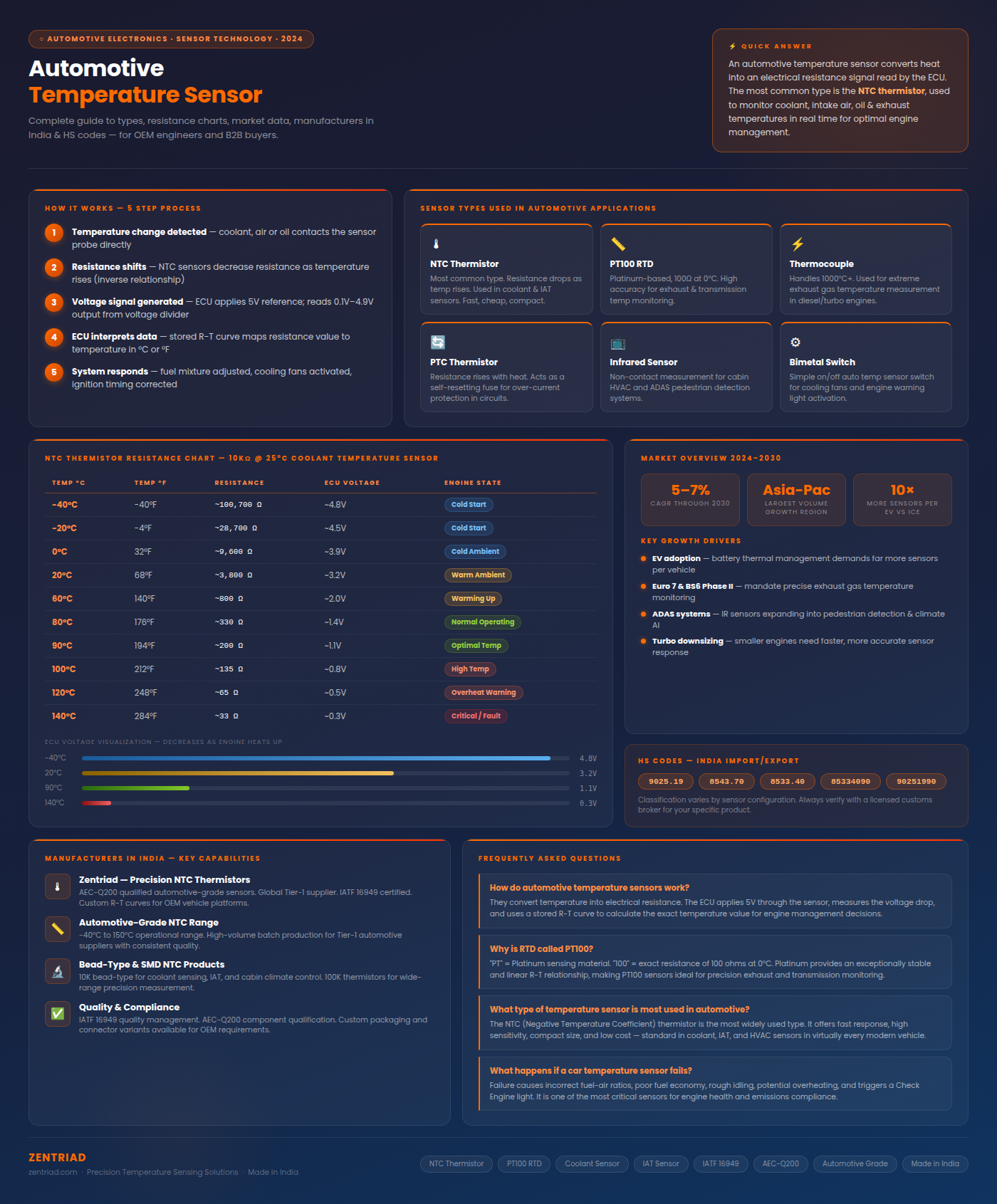
Infographic: How automotive temperature sensors convert thermal changes into electrical signals for ECU processing.
Step-by-Step Operation
- Temperature change detected — Coolant, air, or oil contacts the sensor probe.
- Resistance shifts — NTC thermistors decrease resistance as temp rises; PTC sensors increase resistance.
- Voltage signal generated — ECU reads the voltage divider output (0.1V–4.9V range typical).
- ECU interprets data — The mapped resistance-temperature curve converts the signal to °C or °F.
- System responds — Engine enriches fuel mix, activates cooling fans, or adjusts timing accordingly.
💡 Key fact: A faulty automotive temperature sensor can cause incorrect air-fuel ratios, poor fuel economy, rough idling, and even engine overheating — making it one of the most critical components for engine health monitoring.
Types of Automotive Temperature Sensors
Several sensor technologies are used across different automotive applications. Each type has distinct characteristics suited to specific temperature ranges and accuracy requirements.
🌡 NTC Thermistor
Most common in coolant & IAT sensors. Resistance decreases as temperature rises. Fast response, low cost, compact size.
📏 PT100 RTD
Platinum-based, 100Ω at 0°C. High precision for exhaust & transmission monitoring. Used in premium and diesel vehicles.
⚡ Thermocouple
Used for extreme exhaust gas temperatures (up to 1000°C+). Generates a millivolt signal based on the Seebeck effect.
🔄 PTC Thermistor
Resistance increases with temperature. Used as self-resetting fuses and overcurrent protection in automotive circuits.
🔦 Infrared Sensor
Non-contact temperature measurement. Used in cabin climate control and ADAS (Advanced Driver Assistance Systems).
🧲 Bimetal Switch
Simple on/off auto temp sensor switch for cooling fans and temperature warning lights. Activates at a fixed threshold.
For most passenger vehicles, the NTC thermistor remains the dominant choice due to its sensitivity, small footprint, and compatibility with standard ECU signal conditioning circuits.
Automotive Temp Sensor Resistance Chart
The resistance-temperature relationship is the core diagnostic tool for automotive temperature sensors. Technicians use resistance values to verify sensor health during OBD-II diagnostics or bench testing.
Below is a typical automotive temp sensor resistance chart for an NTC thermistor-based coolant temperature sensor (standard 10kΩ @ 25°C type):
| Temperature (°C) | Temperature (°F) | Typical Resistance (Ω) | Sensor State | ECU Voltage (approx.) |
|---|---|---|---|---|
| -40°C | -40°F | ~100,700 Ω | Very Cold / Cold Start | ~4.8V |
| -20°C | -4°F | ~28,700 Ω | Cold Start | ~4.5V |
| 0°C | 32°F | ~9,600 Ω | Cold Ambient | ~3.9V |
| 20°C | 68°F | ~3,800 Ω | Warm Ambient | ~3.2V |
| 40°C | 104°F | ~1,600 Ω | Warm Up | ~2.5V |
| 60°C | 140°F | ~800 Ω | Warming | ~2.0V |
| 80°C | 176°F | ~330 Ω | Normal Operating | ~1.4V |
| 90°C | 194°F | ~200 Ω | Optimal Temp | ~1.1V |
| 100°C | 212°F | ~135 Ω | High Temp | ~0.8V |
| 120°C | 248°F | ~65 Ω | Overheating Warning | ~0.5V |
| 140°C | 284°F | ~33 Ω | Critical / Fault Zone | ~0.3V |
Note: Values are approximate and vary by manufacturer. Always refer to the OEM specification sheet or the sensor datasheet for exact resistance values.
For applications requiring wider temperature ranges with higher precision, 100kΩ NTC thermistors are commonly specified — offering superior sensitivity in the -40°C to 125°C range typical of automotive environments.
Automotive Temperature Sensor Manufacturers in India
India has emerged as a significant manufacturing hub for precision temperature sensing components, driven by the growth of the domestic automotive OEM sector and increasing export demand.
Key capabilities of Indian temperature sensor manufacturers include:
- Production of NTC thermistors rated for automotive-grade temperature ranges (-40°C to 150°C)
- AEC-Q200 qualified components for under-hood applications
- Custom resistance-temperature curves for OEM vehicle platforms
- High-volume production for Tier-1 automotive suppliers
- Compliance with IATF 16949 quality management standards
Zentriad is a notable manufacturer offering precision NTC thermistors and temperature sensing solutions for automotive and industrial applications, with a proven track record serving global OEM customers. You can explore their customer success stories for application references.
Their 10K bead-type NTC thermistors are particularly suited for coolant temperature sensing, air temperature measurement, and cabin climate control systems in automotive platforms.
HS Code for Automotive Temperature Sensors
Automotive temperature sensors are classified under HS Code 9025.19 (thermometers and pyrometers, not combined with other instruments) or HS Code 8543.70 (electrical machines and apparatus, having individual functions) depending on the sensor configuration. Thermistor-based sensors may also fall under HS Code 8533.40 (variable resistors including rheostats and potentiometers) in certain trade classifications. Always verify with the specific customs authority and product datasheet for accurate classification.
For import/export of NTC thermistor-based automotive sensors in India, the relevant ITC-HS code to check is typically 85334090 or 90251990. Customs classification can vary — always consult a licensed customs broker for final determination.
Automotive Temperature Sensor Market
The global automotive temperature sensor market is on a sustained growth trajectory, driven by several converging trends:
- Electric Vehicle (EV) adoption: EVs require significantly more temperature sensors for battery thermal management, motor cooling, and power electronics — creating a step-change in sensor demand per vehicle.
- Stricter emissions regulations: Euro 7 and BS6 Phase II standards mandate precise exhaust gas temperature monitoring, increasing sensor count in ICE vehicles.
- ADAS integration: Advanced driver assistance systems increasingly use infrared and ambient temperature sensors for pedestrian detection, road condition assessment, and climate control automation.
- Engine downsizing: Turbocharged smaller engines operate at higher temperatures and tighter tolerances, demanding more accurate and faster-responding sensors.
The market is estimated to grow at a CAGR of 5–7% through 2030, with Asia-Pacific — led by China and India — accounting for the largest share of volume growth due to rapid automotive production expansion.
Frequently Asked Questions
How do automotive temperature sensors work?
Automotive temperature sensors work by converting temperature changes into electrical resistance signals. Most use NTC thermistors that decrease in resistance as temperature rises. The ECU reads these resistance values to determine coolant, oil, air, or exhaust temperatures, and adjusts engine parameters — such as fuel injection timing and cooling fan speed — in real time.
Why is RTD called PT100?
PT100 gets its name from two components: "PT" stands for Platinum, the sensing material used, and "100" refers to its exact resistance of 100 ohms at 0°C. Platinum provides an exceptionally stable and linear resistance-temperature relationship, making PT100 sensors ideal for precision measurement in automotive exhaust, transmission, and industrial temperature monitoring applications.
What is the temperature sensor on a car?
A car temperature sensor is an electronic device — typically an NTC thermistor — that monitors temperatures in the engine coolant, intake air, ambient air, and exhaust systems. It sends a resistance-based voltage signal to the ECU, which uses this data to regulate fuel injection, ignition timing, radiator fans, and cabin climate control for optimal engine performance.
What type of temperature sensor is most used in automotive applications?
The NTC (Negative Temperature Coefficient) thermistor is the most widely used type in automotive applications. It offers fast response times, high sensitivity, compact form factor, and low manufacturing cost. NTC thermistors are standard in coolant temperature sensors, intake air temperature sensors, and climate control systems across virtually every modern passenger vehicle globally.
Need Automotive-Grade Temperature Sensors?
Zentriad manufactures precision NTC thermistors and temperature sensors built for the demanding requirements of automotive OEMs and Tier-1 suppliers. Request a specification consultation today.
Get a Free Consultation Explore Products