
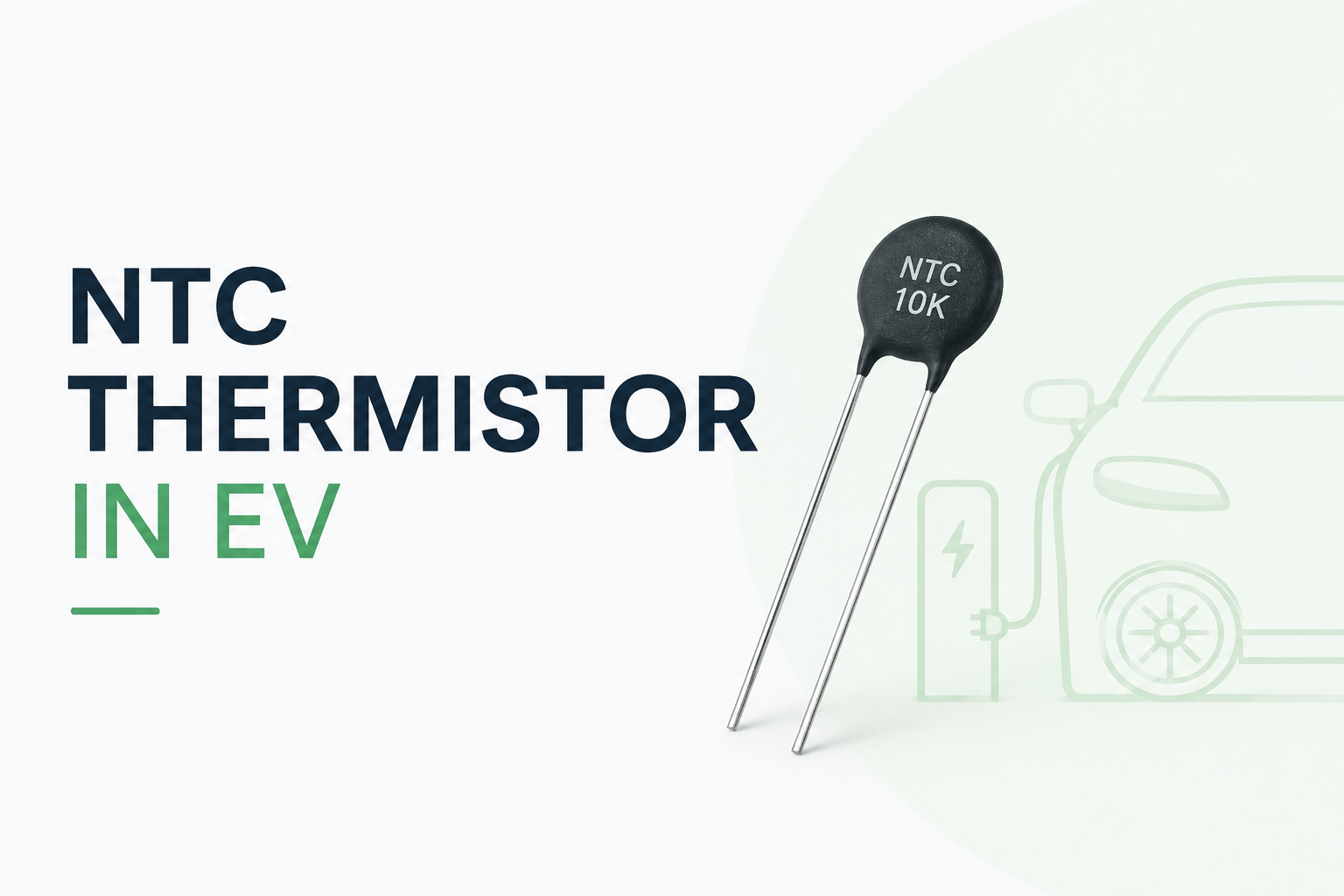
Challenges in EV Thermal Sensing
As electric vehicle technology advances, battery thermal management systems are becoming increasingly complex. Modern EV battery packs operate under high energy density, ultra-fast charging conditions, and continuously changing thermal loads. In these environments, accurate temperature sensing is critical for battery safety, charging efficiency, and long-term reliability.
Although NTC thermistors are widely used in EV battery systems because of their high sensitivity and fast response time, implementing reliable thermal sensing inside lithium-ion battery packs presents several engineering challenges.

1. Uneven Temperature Distribution Inside Battery Packs
One of the biggest challenges in EV thermal management is uneven heat generation across battery cells and modules. During charging and discharging, different areas inside the battery pack can experience varying thermal conditions.
Cells located near the center of the pack often retain more heat, while high-current regions around busbars and power electronics can develop localized hotspots. Without accurate thermal sensing, these temperature variations may go undetected and accelerate battery degradation.
To improve thermal visibility, EV manufacturers deploy multiple NTC thermistors across critical thermal zones within the battery architecture.
2. Sensor Placement Limitations
EV battery packs are highly compact, leaving limited space for temperature sensor integration. Improper thermistor placement can lead to inaccurate readings and delayed thermal detection.
In many cases, poorly positioned sensors measure surrounding air temperature rather than actual battery cell temperature. This reduces the effectiveness of the Battery Management System (BMS) during high thermal stress conditions.
To improve sensing accuracy, manufacturers use:
- Direct-contact thermistor mounting
- Thermal interface materials
- Multi-point temperature sensing layouts
- Precision adhesive bonding techniques
3. Fast Charging Creates Rapid Thermal Spikes
DC fast charging generates substantial heat within lithium-ion battery cells. As charging speeds increase, battery temperatures can rise rapidly within a very short period of time.
Temperature sensors must respond immediately to detect thermal spikes before they evolve into dangerous overheating conditions or thermal runaway events.
This is why EV manufacturers prefer high-sensitivity NTC thermistors capable of delivering rapid thermal feedback to the BMS.
4. Vibration and Mechanical Stress
Electric vehicles operate under continuous vibration, road shock, and mechanical stress. Over time, these conditions can affect thermistor positioning, wire stability, and thermal contact accuracy.
If a thermistor loses proper contact with the battery surface, temperature readings may become unreliable. Automotive-grade NTC thermistors are therefore designed with reinforced encapsulation, durable leads, and vibration-resistant structures to ensure long-term operational stability.
5. Moisture and Environmental Exposure
EV battery systems are exposed to humidity, condensation, coolant exposure, and temperature cycling. Moisture ingress can alter sensor resistance characteristics and reduce sensing accuracy over time.
To improve environmental durability, EV manufacturers use:
- Epoxy-coated thermistors
- Glass-sealed NTC sensors
- Moisture-resistant encapsulation
- Automotive-grade insulated wiring
6. Thermal Lag and Poor Heat Transfer
Thermal lag occurs when heat transfer between the battery cell and the thermistor is inefficient. Air gaps, low-conductivity materials, or improper mounting can delay temperature detection.
Even small sensing delays can impact:
- Battery safety
- Cooling system response
- Charging performance
- Cell balancing accuracy
To minimize thermal lag, manufacturers optimize sensor positioning, thermal interface materials, and mounting pressure.
7. Electrical Noise and Signal Stability
EV battery systems contain high-power electronic components such as inverters, DC-DC converters, and charging modules. These systems generate electromagnetic interference (EMI) that can affect temperature sensor signal stability.
To ensure accurate thermal monitoring, manufacturers use shielded wiring, filtered signal circuits, and stable grounding architectures within the BMS.
8. Long-Term Sensor Drift
Over time, repeated thermal cycling and environmental stress can gradually alter thermistor characteristics. This phenomenon, known as sensor drift, may reduce temperature measurement accuracy throughout the vehicle lifecycle.
High-quality automotive thermistors are manufactured using stable ceramic materials and precision calibration processes to minimize long-term drift and maintain reliable sensing performance.
Why Accurate Thermal Sensing Matters in EV Systems
Reliable thermal sensing is essential for maintaining:
- Battery safety
- Fast-charging stability
- Thermal balancing efficiency
- Battery lifespan
- Overall EV performance
As EV battery technologies continue evolving, advanced thermal sensing systems using high-precision NTC thermistors will remain critical for safer, smarter, and more efficient electric vehicles.