
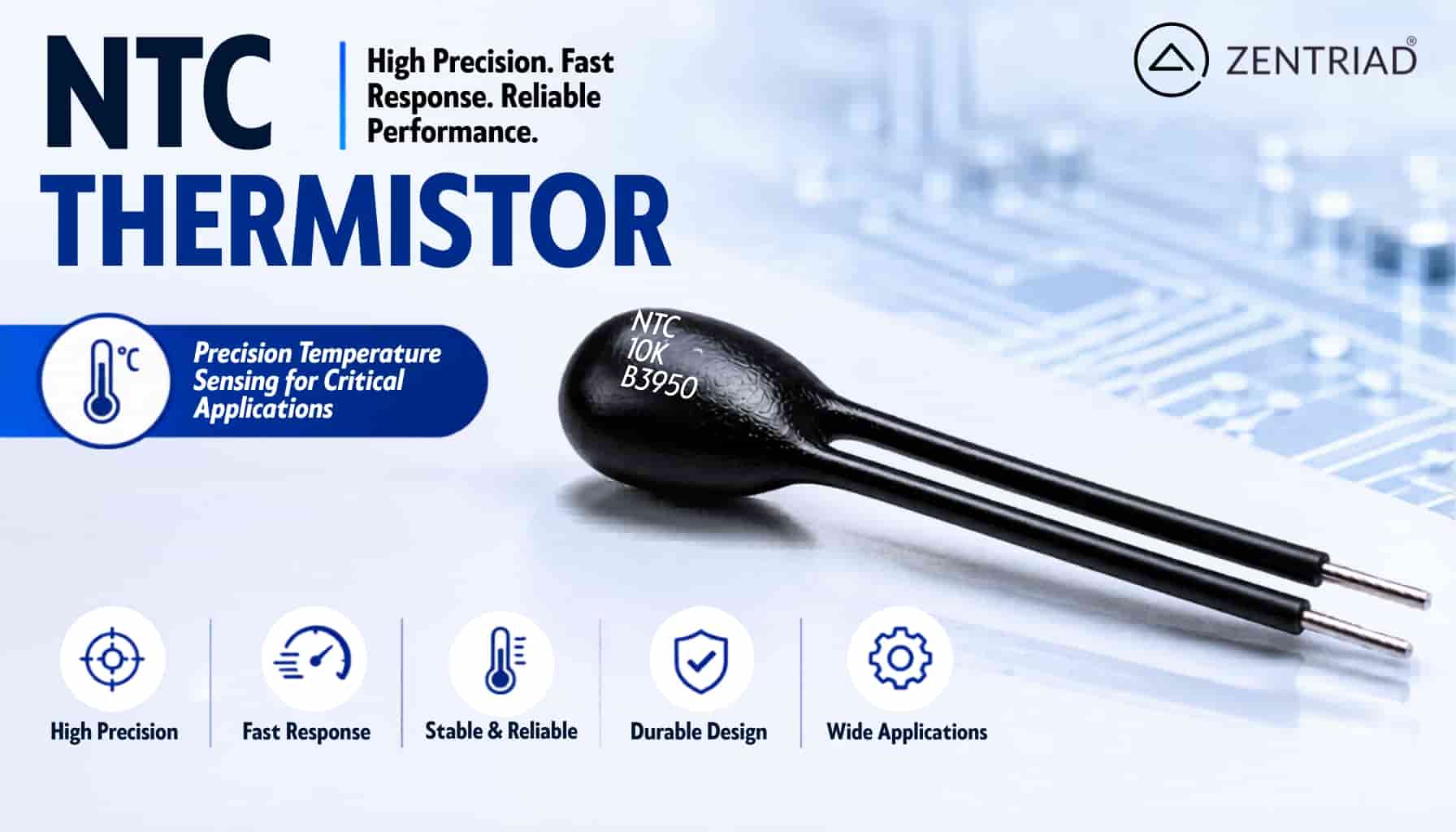
Why EV Manufacturers Prefer NTC Thermistors
Electric vehicle battery systems operate within extremely sensitive thermal conditions. Even small temperature deviations inside a lithium-ion battery pack can affect:
- Charging efficiency
- Driving range
- Battery lifespan
- Power delivery
- Safety performance
Because of this, EV manufacturers require temperature sensors that are:
- Highly responsive
- Compact
- Accurate
- Reliable under vibration
- Cost-efficient for large-scale production
This is why NTC thermistors have become one of the most widely used temperature sensing components in modern electric vehicle battery systems.
High Sensitivity in Critical Temperature Ranges
One of the biggest advantages of NTC thermistors is their exceptionally high sensitivity within the operating temperature range of lithium-ion batteries.
Unlike many alternative temperature sensors, NTC thermistors can detect even minor temperature fluctuations rapidly and accurately.
This high sensitivity is critical during:
- Fast charging
- Regenerative braking
- High-load acceleration
- Thermal balancing between cells
In EV battery packs, temperature differences of only a few degrees can create uneven cell aging. Accurate thermal monitoring allows the Battery Management System (BMS) to maintain balanced operating conditions across the entire pack.
Fast Thermal Response Time
Battery temperatures can rise very quickly during:
- DC fast charging
- Aggressive driving
- High ambient temperature operation
NTC thermistors respond rapidly to thermal changes because of their:
- Small thermal mass
- Compact structure
- Direct contact mounting capability
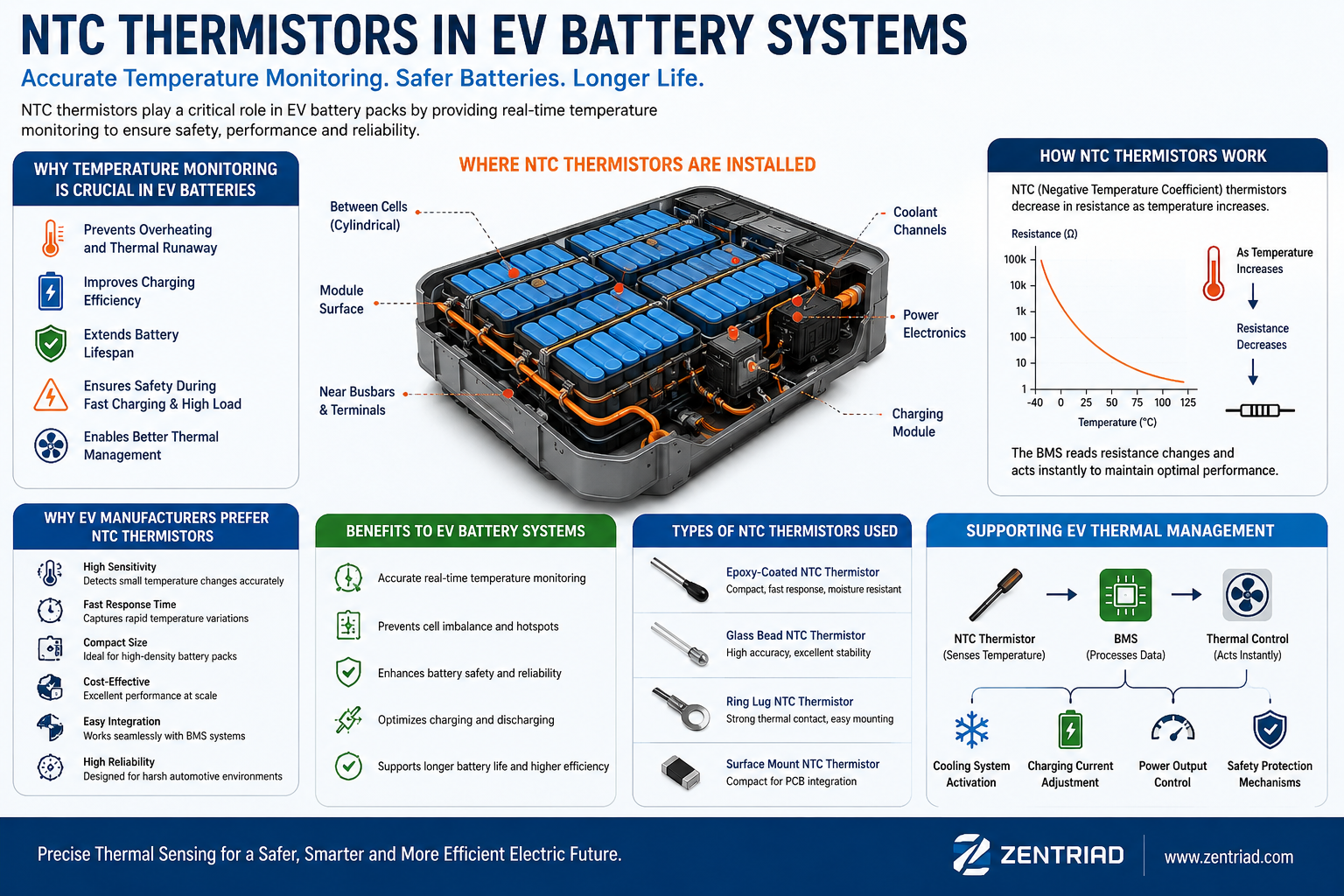
This enables the BMS to react immediately by:
- Activating cooling systems
- Limiting charging current
- Reducing power output
- Triggering safety protection mechanisms
Fast thermal response is one of the primary reasons NTC thermistors are preferred over slower sensing technologies in EV applications.
Compact Size for Dense Battery Pack Integration
Modern EV battery packs contain hundreds or even thousands of tightly packed cells. Space optimization is a major engineering challenge.
NTC thermistors are extremely compact, allowing manufacturers to place them:
- Between cylindrical cells
- Near pouch cells
- Inside cooling channels
- Close to busbars
- Around charging circuits
Their small footprint enables accurate thermal monitoring without significantly increasing battery pack size or weight.
This is especially important in:
- Electric cars
- Electric scooters
- Battery energy storage systems
- High-density EV platforms
Cost Efficiency for Mass Production
Automotive manufacturing requires components that can scale efficiently across large production volumes.
Compared to other sensing technologies such as RTDs or infrared thermal systems, NTC thermistors provide:
- Lower component cost
- Simpler circuit integration
- Reduced manufacturing complexity
- Excellent performance-to-cost ratio
For EV manufacturers producing thousands of battery packs, this cost advantage becomes significant without compromising thermal protection performance.
Easy Integration With Battery Management Systems (BMS)
NTC thermistors integrate easily into existing BMS architectures. Their resistance-based output can be processed efficiently using:
- Analog-to-digital converters
- Voltage divider circuits
- Embedded monitoring systems
This simplifies:
- Sensor calibration
- Thermal mapping
- Diagnostic algorithms
- Battery protection logic
Because of their predictable resistance-temperature characteristics, NTC thermistors are highly compatible with modern EV control systems.
High Reliability in Harsh Automotive Environments
Electric vehicles expose components to demanding conditions, including:
- Constant vibration
- Moisture exposure
- Rapid temperature cycling
- Road shock
- Electromagnetic interference
Automotive-grade NTC thermistors are designed with:
- Epoxy coatings
- Glass encapsulation
- Insulated leads
- Moisture-resistant sealing
to maintain stable performance over long operating lifecycles.
This reliability is essential for EV battery systems expected to operate safely for many years.
Better Thermal Mapping Across Battery Packs
Large EV battery packs require multiple sensing points to monitor temperature distribution effectively.
Because NTC thermistors are:
- Small
- Affordable
- Highly sensitive
manufacturers can deploy many sensors throughout the battery pack for accurate thermal mapping.
This helps identify:
- Localized hotspots
- Uneven cooling
- Abnormal charging behavior
- Early thermal instability
before serious failures occur.
Preferred Choice for Fast-Charging EV Platforms
As EV manufacturers move toward ultra-fast charging systems, thermal control becomes even more critical.
Fast charging generates substantial heat inside:
- Lithium-ion cells
- Connectors
- Charging modules
- Power electronics
NTC thermistors provide the rapid thermal feedback needed to safely manage these high-energy charging conditions.
This makes them a key component in next-generation EV battery safety systems.
Supporting Longer Battery Lifespan
Battery degradation accelerates when cells operate outside optimal temperature ranges.
By enabling precise thermal monitoring, NTC thermistors help:
- Reduce thermal stress
- Improve charging consistency
- Maintain balanced cell temperatures
- Prevent overheating cycles
This contributes directly to:
- Longer battery life
- Improved driving range stability
- Safer EV operation
- Lower maintenance risk
For EV manufacturers, accurate thermal sensing is not just a safety feature — it is a critical factor in long-term battery performance and customer reliability.